

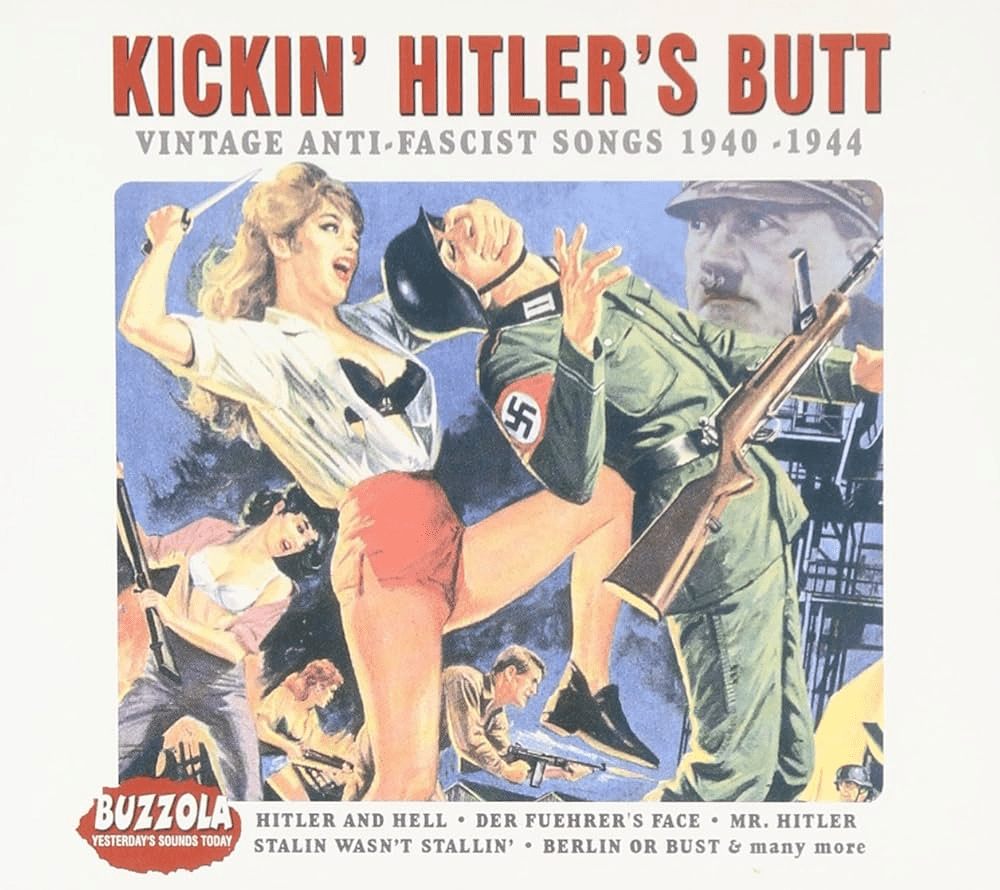
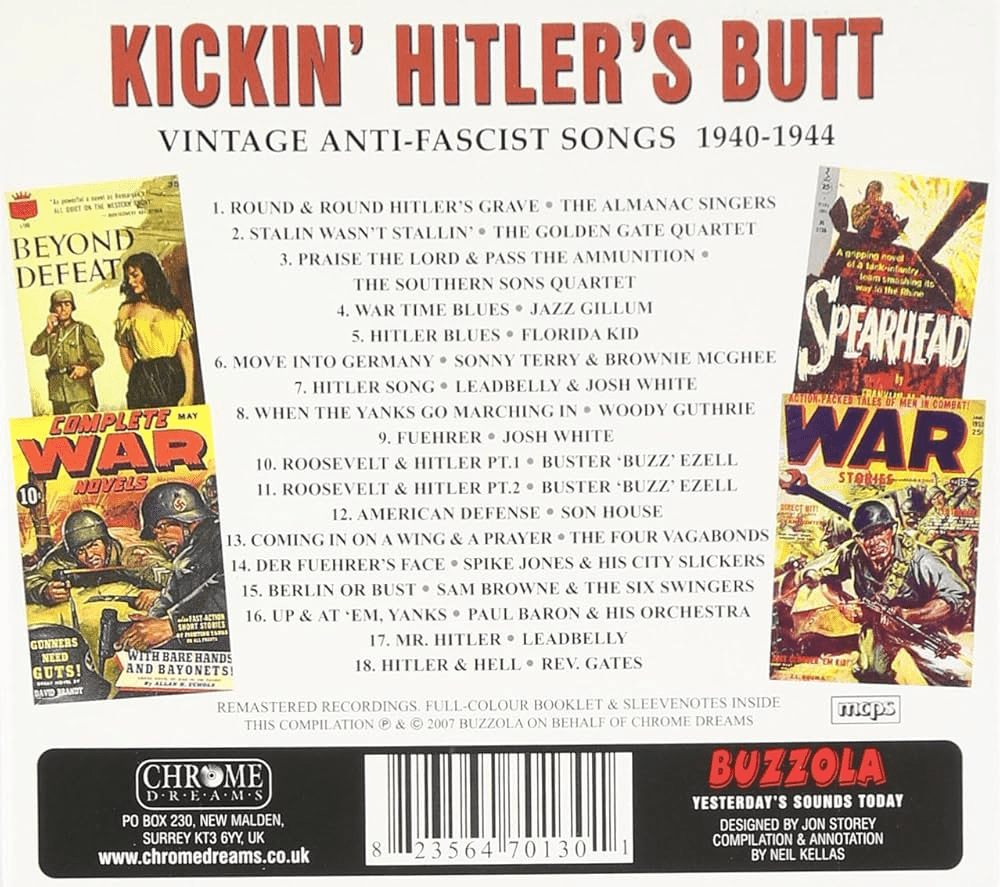
“Kickin’ Hitler’s Butt: Vintage Anti-Fascist Songs 1940-1944” – An Annotated Playlist (Tracks 7 & 17)
Welcome Back!
If you’ve been following along, you’ll likely notice a few formatting changes in this post. This new streamlined approach will allow me to focus on the music, without getting bogged down in historical and biographical detail that is readily available elsewhere. It will also allow me to post more regularly over a greater range of topics. I’ll continue to share links that I found useful for folks wishing to dig deeper. If there’s anything essential you feel I’ve left out, let me know in the comments; I’m happy to consider your suggestions. Thanks for reading!
If you’re joining us for the first time, welcome! While in one way each discussion will build on the last, ultimately I’ve organized the series in a way that allows each post to stand on its own. If you have yet to listen this excellent compilation, this link will take you to my recreation of it in the form of a YouTube playlist. If you happened to give my channel a follow while you’re there, I’d be much obliged : )
If you’d prefer to start at the beginning of this series, here’s a link to the Introduction.
And Now…Today’s Track!
There’s a mystery at the heart of today’s tracks; one I’ve been puzzling over since I first attempted to recreate the Kickin’ Hitler’s Butt compilation on YouTube in the earliest stages of this project; one I’m hoping someone reading this can help me unravel. The question is this:
Are Track 7: ‘Hitler Song’ and Track 17: ‘Mr. Hitler’ actually the same song?
If yes, it would explain why so many sources refer to the song as both ‘Hitler Song’ and ‘Mr. Hitler;’ including Wikipedia, YouTube, and Smithsonian Folkways, who included the song in their excellent Lead Belly collection of 2015.
But if that’s true, why is the song featured twice in this compilation? If there are two versions, you’d think they’d need to be different enough to warrant the inclusion of both. And there are some clues pointing to some possible differences. Track 7 credits Josh White as a performer and, according to Apple Music, has a runtime of over 4 1/2 minutes. That adds one performer (White) and about ninety seconds to what we find for Track 17, which is credited solely to Lead Belly. So what we’d hope to find in Track 7 is an extended version of Track 17, with a clear contribution by Josh White on vocals and/or guitar.
What we find instead, or rather, don’t find…is any alternate version of Track 17 at all–at least not one we can listen to. Apple Music appears to offer a ninety-second sample of Track 7, which I was able to play, but to my ears it sounds identical to Track 17. I asked a friend who subscribes to the Apple Music to try the track, and he said it’s not actually available. I looked to Genius for help, which had an individual page for each track, but found the lyrics for “both” tracks were nearly identical.
Setting all that confusion aside–at least for now–we’re going to proceed under the assumption that these two songs are (more or less) the same song.
The Artist
Huddie Ledbetter aka Lead Belly (1888-1949)
Folk legend. Blues icon. King of the Twelve-String. Whatever you call him, Lead Belly was the living embodiment of the Great African-American Songbook, with a vast repertoire including “work songs, prison songs, ring chants, cowboy songs, games, and Tin Pan Alley to the Delta blues.” And most importantly, at least for the purposes of this blog, the First Great American Protest songwriter and singer.
The Song
Mr. Hitler (aka Hitler Song) – Lead Belly
Genre/Style: Blues/Folk
Year: 1942
Written & Performed by: Lead Belly
Here are a few things to consider while listening to ‘Hitler Song’:
- Is the song more folk or blues? Does the distinction matter?
- How does the music conform to or deviate from what you’d expect from a standard folk or blues song?
The Music
Is it Folk? Is it Blues? Why not both? The verses are quintessential 12-bar blues, but the chorus has a singalong quality that’s more commonly found in folk songs (like Track 1: Round and Round Hitler’s Grave, for example). This transition of styles comes with another change, as the mid-tempo verses rev up to something more toe-tapping for the chorus, and then back down again in a pattern that’s repeated throughout.
The most popular tab on Ultimate Guitar has the song in D Major, with a I-IV-V7 chord progression. This is a common progression in both folk and blues music, and is sometimes referred to as a “three-chord trick.”
Rhythm and harmony for the track are provided by Stella, Lead Belly’s signature 12-string acoustic guitar. The only thing more remarkable than his playing is his voice: always passionate, powerful, and tinged with a world-weary wisdom.
The Lyrics
Read the Full Lyrics on Genius
Intro
When Lead Belly says, “Do that again, I did not understand you that time. Take it easy.” in the spoken intro, who exactly is he giving instructions to? If Josh White were indeed playing guitar on the track, he would be a prime suspect. But as I’ve stated above, it’s unclear what role, if any, he played in the performance of this song. Perhaps he was unhappy with his own playing, and trying to get in tune with Stella, his guitar.
Chorus
We’re gonna tear Hitler down… / We’re gonna bring him to the ground… / Someday
Chorus
The chorus is repeated four times, occurring after every verse but the last. It repeats the opening line three times, ending with “someday.” It then repeats a new line three times, with the same ending. In addition to that repetition, the two sections are tied together lyrically by the rhyme “down/ground.”
Verses
The rest of the lyrics are just as straightforward. The first two verses say more or less the same thing: Hitler has wrongfully driven the Jews from their homes.
You ain’t no iron, you ain’t no solid rock / But we American people say, “Mr. Hitler, you is got to stop!”
Verse 3
Rather than focusing on what Hitler is, or has done, here Lead Belly states what Hitler is not: He is not strong like iron. He is not solid like a rock. If he is not those things, it follows that he’s likely the opposite of those things: weak and malleable. LB then speaks for the American people as a whole with an unequivocal, emphatic “stop!”
Reflections
For me, ‘Mr. Hitler’ isn’t among Lead Belly’s best protest songs (‘Bourgeois Blues’ has it beat by a mile), even though it is one of his best known. Even coming from a man of his talent, neither the music nor the words of the track strike me as particularly poignant or even memorable.
There’s much more to say about Lead Belly’s contribution to the Great American Protest Songbook, and I plan to dig into his life and work in more detail in a series of posts in the near future. So stay tuned for that!
Links
Song Lyrics – Genius
Song Page – Wikipedia
Artist Page – Wikipedia
Lead Belly – Smithsonian Center For Folklife & Cultural Heritage
Lead Belly – Cultural Equity
Come Back Next Time for Woody Guthrie’s ‘When the Yanks Go Marching In.’
Disclaimer
~Content was created without the use of A.I.~
~Media content may be subject to copyright~
~Original content © Adam Astra 2026~

 Adam Astra