
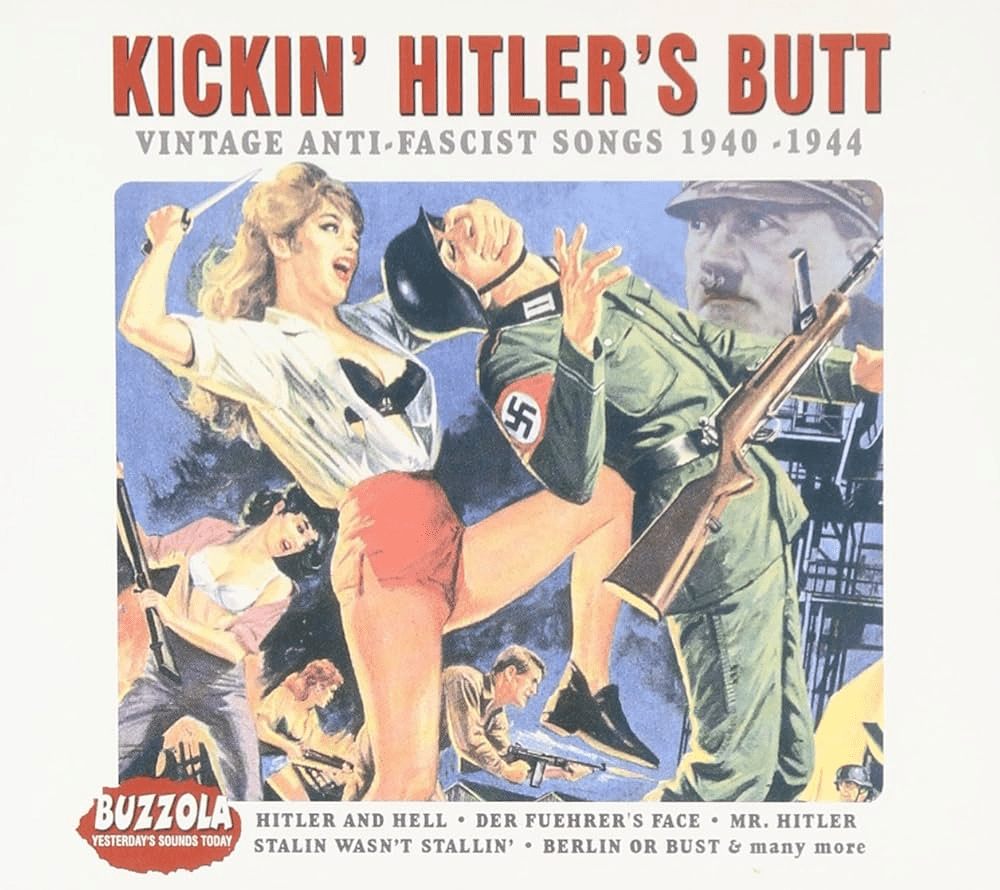
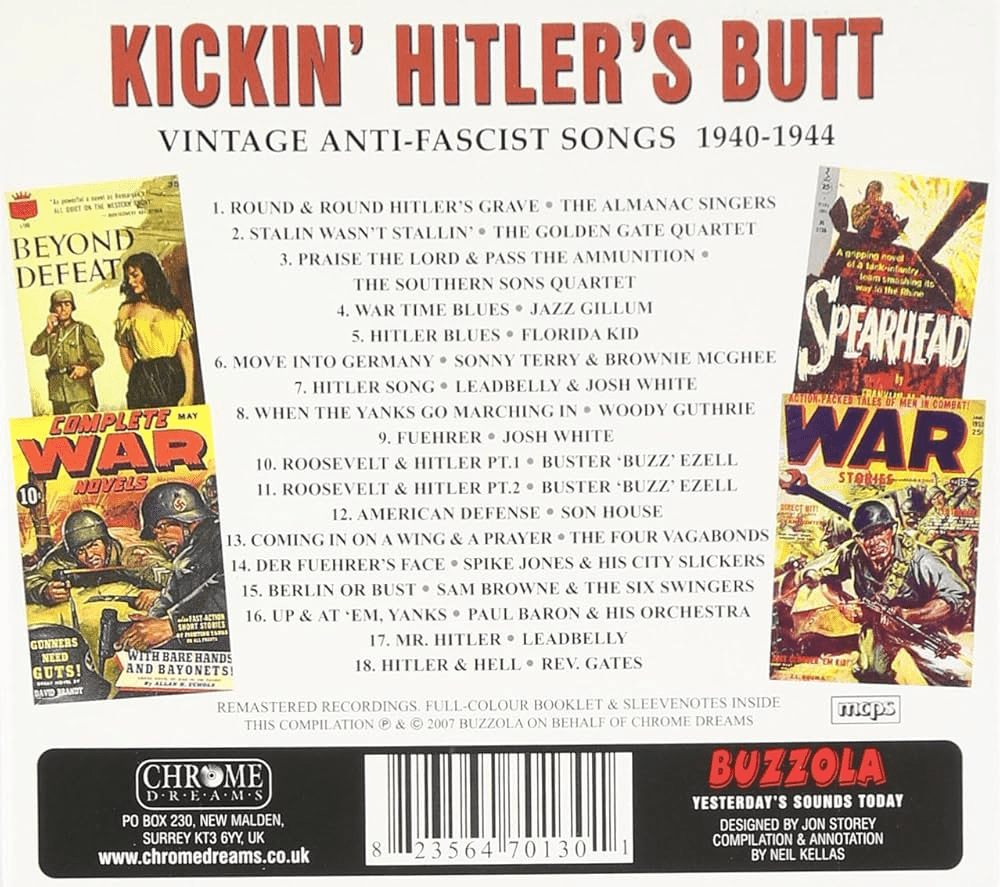
“Kickin’ Hitler’s Butt: Vintage Anti-Fascist Songs 1940-1944” – An Annotated Playlist (Track 6)
Welcome Back!
We’re about a third of the way through the compilation and movin’ right along! Today’s track–Track 6: ‘Move Into Germany’ by Sonny Terry & Brownie McGhee and featuring Josh White–has some of the Blues we enjoyed in our last two tracks. In addition, the fast-paced, upbeat tempo and singalong chorus give it a touch of folk akin to what we heard from the Almanac Singers on Track 1.
Let’s learn a little bit about the players before pressing play on today’s track.
If you’re joining us for the first time, welcome! While in one way each discussion will build on the last, ultimately I’ve organized the series in a way that allows each post to stand on its own. If you have yet to listen this excellent compilation, this link will take you to my recreation of it in the form of a YouTube playlist. If you happened to give my channel a follow while you’re there, I’d be much obliged : )
If you’d prefer to start at the beginning of this series, here’s a link to the Introduction.
Introduction
The Artists
Sony Terry & Brownie McGhee
Sonny Terry & Brownie McGhee were one of the great Blues duos in American music history. Terry’s evocative harmonica playing (and occasional whoops and hollers) provided a lively accompaniment to Brownie’s rhythmic acoustic guitar and Blues vocals. Together they helped to develop a style of music, born out of the American south, which came to be known as “The Piedmont Blues.”
“Piedmont blues (also known as East Coast, or Southeastern blues) refers primarily to a guitar style, which is characterized by a fingerpicking approach in which a regular, alternating thumb bass string rhythmic pattern. supports a syncopated melody using the treble strings generally picked with the fore-finger, occasionally others. The result is comparable in sound to ragtime or stride piano styles. The Piedmont style is differentiated from other styles, particularly the Mississippi Delta blues, by its ragtime-based rhythms.” – Wikipedia
Josh White
The addition of Josh white on harmony vocals and acoustic guitar is always a welcome one. Josh White has become a new favorite of mine while researching for this project, and we’ll be talking a lot more about him when we get to Track 9: Fuhrer.
And Now…Today’s Track!
Here are a few things to consider while listening:
- Is the song more folk or blues? Does the distinction matter?
- How does the music conform to or deviate from what you’d expect from a standard folk or blues song?
- Can you identify the ragtime rhythm associated with the Piedmont Blues sound?
- What do Sonny Terry’s harmonica and vocalizations add to the overall sound of the track?
Track 6: Move Into Germany – Sonny Terry & Brownie McGhee
Genre/Style: Blues, Folk, Country
Year: 1944
Players: Sonny Terry, Brownie McGhee, Josh White
Listen to the song again while reading the lyrics and consider the following:
- Are the lyrics specific or general?
- Are there lines or phrases you’ve heard in other songs?
The Song: Overview
Brownie McGhee is given songwriting credit for this 12-bar Blues track.
Title
The title offers both a setting and a subject for the song and is well-represented, being repeated throughout the lyrics.
The Music
Sonny Terry’s lively harmonica introduces the song, quickly followed by Brownie’s rhythm guitar. Brownie sings the verses, and is joined by Josh White singing backup on the chorus. White also does some soloing on his own guitar.
The Words
The song makes frequent use of what in songwriting terms is known as a floating lyric: a line or pair of lines that can easily be inserted into any song to set up a rhyme.
Verse 1
I wrote Hitler a letter, this is how it read / Won’t be long we make up your dying bed
Verse 1
The song opens with a floating lyric, setting up the rhyme “read/bed.”
The “dying bed” phrase is likely a reference to the 1920s gospel Blues song ‘In My Time of Dying’ aka ‘Jesus Make Up My Dying Bed’ by Blind Willie Johnson. Bob Dylan covers the song on his debut album, which is likely the first place I encountered it.
Chorus
We’re gonna move into Germany, sure you know / We’re gonna move into Germany, won’t be long / We’re gonna move into Germany, change this old world around
Chorus
Brownie McGhee and Josh White sing together on the chorus, each line beginning with the refrain (which is also the title). This tried and true songwriting technique uses repetition to create a song that is both cohesive and memorable.
Verse 2
You can phone Harry Heath, he’s down in Tokyo…you meet, down you go
Verse 2
Who is Harry Heath and what’s he doing in Tokyo? I’m afraid I do not have an answer to those two questions. Perhaps it’s a name that McGhee heard on the news or read in a newspaper as he was writing the song. Protest songs are often topical, with names and events pulled directly from the headlines, so this is my best guess.
There are a few instances in this recording where the audio quality fails and the lyrics become unintelligible. If you’re able to make out any of the missing lyrics, please let me know and I will add them to the song page on Genius.
Verse 3
Hitler didn’t like our peaches, he shook our tree / Sunk our ships out on the sea
Verse 3
“Hitler didn’t like our peaches” is kind of a funny line. Working a floating lyric into a topical song doesn’t always go seamlessly.
Verse 4
I’ve got myself a bulldog, set of two greyhounds / Gonna use my dogs to throw Hitler down
Verse 4
Another floating lyric. This time they’re siccing the dogs on Hitler. As a lover of dogs and hater of fascists, I wholeheartedly approve.
Verse 5
You can tell old Hitler put out his dying call / Thinking blood is wine, the way to hell he goes
Verse 5
The symbolism is clearly Christian, but I’m a little unclear on what the the first half of the verse is trying to say. Maybe the songwriter is calling Hitler blood-thirsty and drunk with power. The “to hell he goes” part is pretty straightforward, though.
Verse 6
It takes a rocking chair to rock, rubber to roll / … to satisfy Hitler’s soul
Verse 6
This final verse features an inconvenient combination of floating lyrics and indecipherable vocals. I’m sure the phrase “satisfy [blank’s] soul” is older than even this 1944 song, but when I hear it I always think of Tom Waits’ song ‘Chocolate Jesus,’ from his 1999 album Mule Variations.
Reflections
While ‘Move Into Germany’ isn’t the most memorable of the tracks, it’s an easy listen, and I was happy to learn more about one of Blues’ greatest duos: Terry and McGhee. And my interest in and appreciation for Josh White continues to grow.
Links
The YouTube video linked above is sourced from the 1996 compilation album That’s Why We’re Marching: World War II And The American Folk Song Movement released by Smithsonian Folkways. If you enjoy Kickin’ Hitler’s Butt, this one is also worth a listen.
Song Lyrics – Genius
Sonny Terry – Wikipedia
Brownie McGhee – Wikipedia
Josh White – Wikipedia
Piedmont Blues – Wikipedia
Come Back Next Time for Lead Belly’s ‘Hitler Song/Mr. Hitler’
Disclaimer
~Content was created without the use of A.I.~
~Media content may be subject to copyright~
~Original content © Adam Astra 2026~