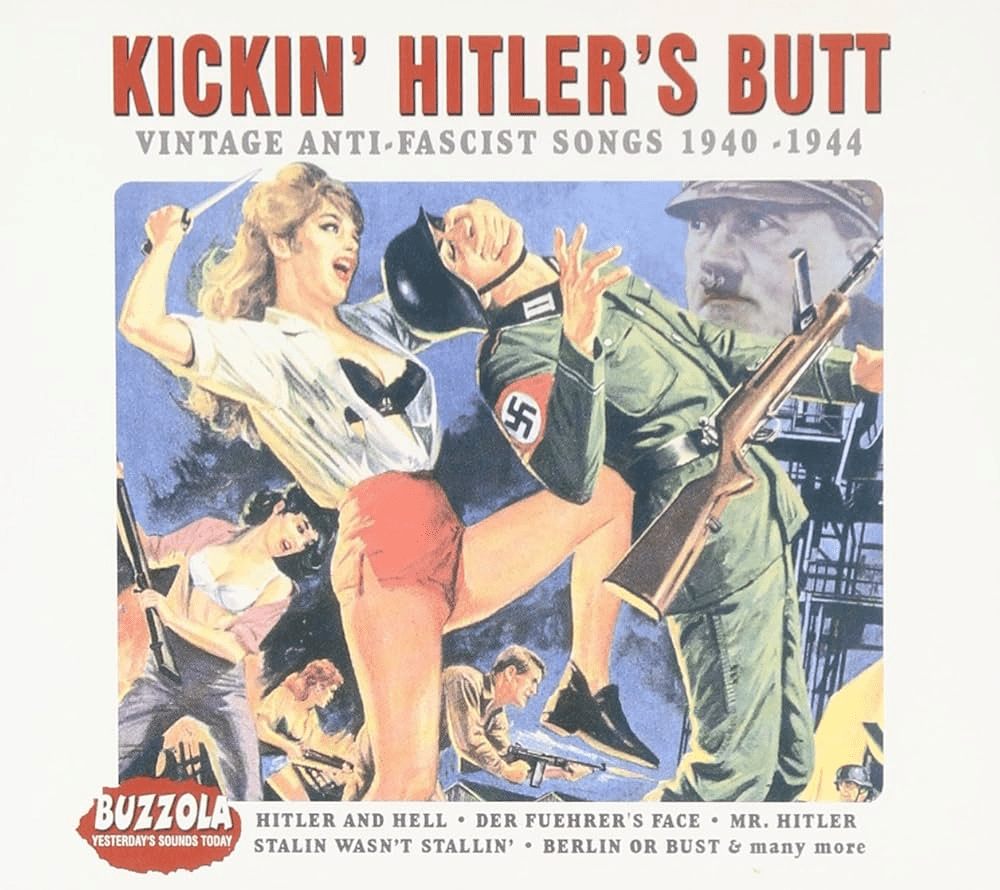
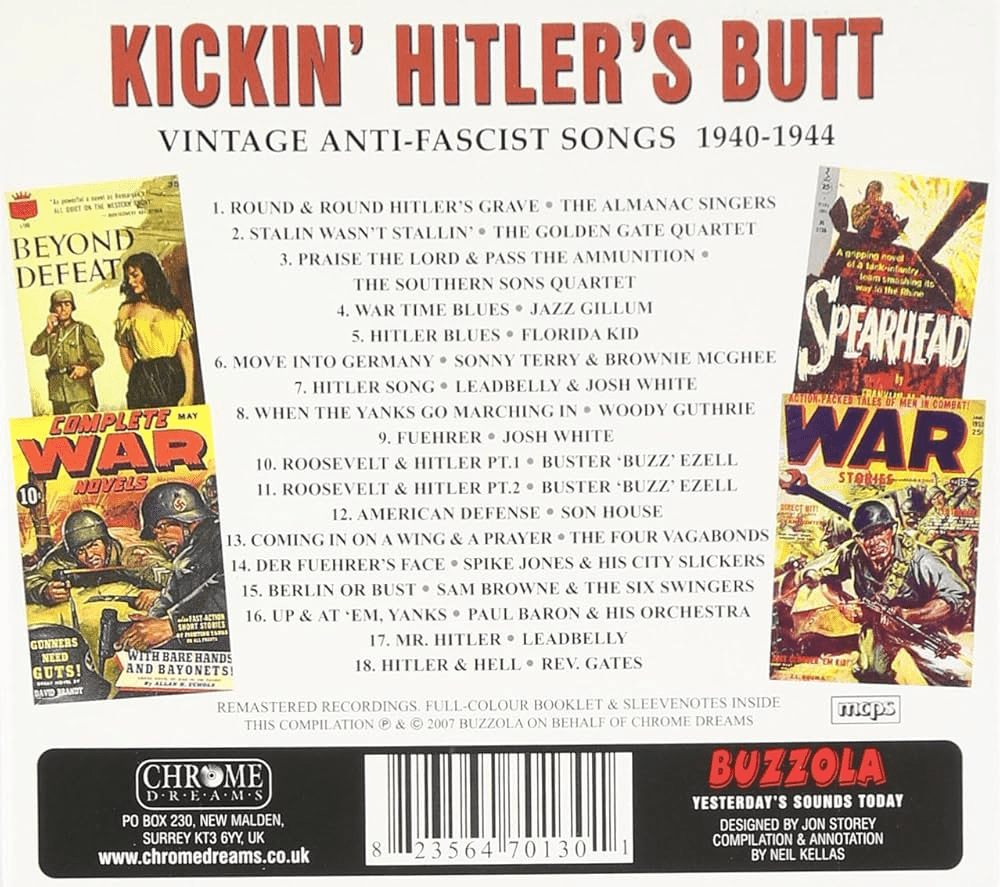
“Kickin’ Hitler’s Butt: Vintage Anti-Fascist Songs 1940-1944” – An Annotated Playlist (Track 2)
Welcome Back!
Today we’re discussing Track 2: ‘Stalin Wasn’t Stallin” by The Golden Gate Quartet. This is the first of three Black male A capella group performances featured on this album, and it will be interesting to compare their contributions as we progress through the series.
As you can tell by the punny title, today’s song approaches its subject—the role of Russia and its leader, Joseph Stalin, in helping the Allies to beat back Hitler’s advancing army—with more than a little bit of humor.
You’ll notice right away that the performance style is very much of its time. And while the quality of the recording is admittedly less than stellar, that doesn’t have to keep us from enjoying the song for what it is, and what it can tell us about the history of recorded music in America.
If you’re joining us for the first time, welcome! While in one way each discussion will build on the last, ultimately I’ve organized the series in a way that allows each post to stand on its own. If you have yet to listen this delightful compilation, this link will take you to my recreation of it in the form of a YouTube playlist. If you happened to give my channel a follow while you’re there, I’d be much obliged : )
If you’d prefer to start at the beginning of this series, here’s a link to the Introduction.
Before we get into the music, let’s learn a little about the people involved.
The Golden Gate Quartet
According to one source, it all started in a barbershop—a fitting beginning for any quartet—in Norfolk, Virginia. It was there, in 1934, that a one-legged bass vocalist by the name of Robert “Peg” Ford and tenor singer A.C. “Eddie” Griffin (the owner of said barbershop) decided to create an all-male four-piece A capella group that would specialize in the style of gospel singing known as “jubilee.”
Unlike, say, the older Alabama gospel tradition, with its trademark reliance on formal song structure and straight-ahead harmonies, Virginia’s gospel music was looser, and more rhythmic. Influenced by such varying sources as the pop group Mills Brothers, the swinging jazz of the Three Keys, and the emotional wailing of area pulpit preachers, jubilee singing was something daring and exciting – gospel music geared for the body as well as the soul. – interjazz.com
Knowing their group needed a spark of youthful energy, they visited the local high school, Booker T. Washington, and recruited two young singers from the glee club: second tenor Henry Owens and baritone Willie (sometimes spelled Willy) Johnson.
A short time later, Peg and Eddie were replaced by two more students: William Langford (first tenor) and Orlandus Wilson (bass). It was these four young Black singers who began performing, first in churches and later on local radio, as The Golden Gate Jubilee Quartet.
And they had quite a bit of success. In 1938 alone, they performed in John Hammond’s historic From Spirituals to Swing concert at Carnegie Hall, and released two of their most popular records: the spiritual ‘John the Revelator,’ which would later be inducted into the National Recording Registry, and ‘Golden Gate Gospel Train,’ which would earn them national radio airplay and become a signature song for the group.
Two years later, they signed a new contract with Okeh, a subsidiary of Columbia Records, and officially changed their name to The Golden Gate Quartet. It’s around this time that Willian Langford left the group and was replaced by Clyde Riddick. This would usher in a new era of departures and replacements for the group.
The Quartet made history again in 1941, as the first Black musical group to sing at Constitution Hall, after being invited to perform at the inauguration of Franklin D. Roosevelt.
Ninety (yes, NINETY) years later, the group remains active. Its longest-standing member, Orlandus Wilson, was active in the group for sixty-three years, from 1934 to 1998. He joined at the tender age of 16, though he did miss one year, 1944…but you can’t blame a guy for getting drafted. In addition to being a talented bass vocalist, Wilson was active in arranging and composing for the group. Of the four founding members, only Wilson has his own Wikipedia page.
If you’re interested in knowing more about the group’s many members, here’s a timeline from Wikipedia
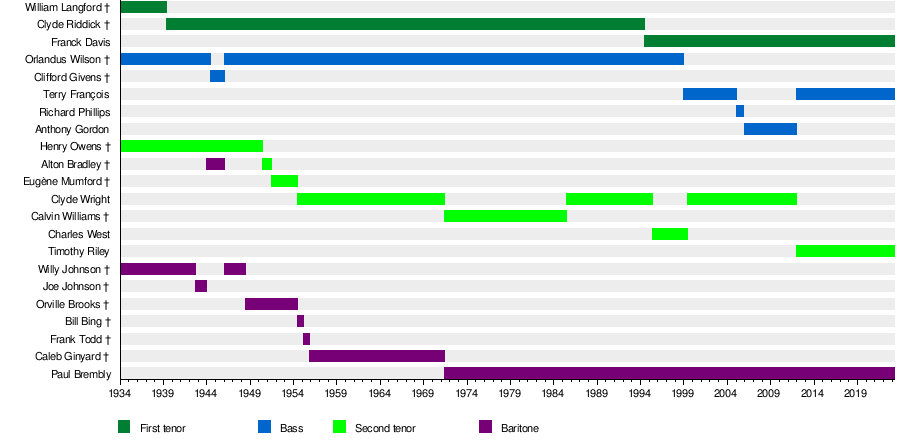
Keeping this brief bio in mind, let’s listen to today’s track!
Track 2: Stalin Wasn’t Stallin’ – Golden Gate Quartet
Genre/Style: Vocal (Male), A capella
Song by: Willie Johnson
Year: 1943
Singers: Willie Johnson, Henry Owens, Orlandus Wilson, Clyde Riddick
Stalin wasn’t stallin’ / When he told the beast of Berlin / That they’d never rest contented / Till they had driven him from the land
Chorus
Listen & Read
Listen to the track again, this time while reading over the lyrics.
The Song
The Songwriter
Willie Johnson, it turns out, is a common name among musicians of the time. Early Blues enthusiasts will have heard of the gospel Blues singer and guitarist, ‘Blind’ Willie Johnson. Electric Blues fans may know the guitarist Willie Johnson, famous for his work with Blues legend Howlin’ Wolf. I had to do some digging, but finally found the Willie Johnson I was looking for: Bill ‘Willie’ Johnson, songwriter, baritone, and original member of the Golden Gate Quartet. Unfortunately, there’s no Wikipedia page for Willie, and further information is hard to come by.
Structure
C1-V1-V2-V3-C2-V4-V5-C3-V6-C4
The Title
A pun in a title sets a tone—it says, “we’re having fun with it” at its best, and “aren’t we clever?” at its worst. There is definitely a fine line between the two. With a title like ‘Stalin Wasn’t Stallin’,’ I think we’ve got to take the humor that the wordplay suggests as intentional. Whether or not the humor is successful is mostly up to the listener.
The Chorus
Since the chorus, which begins the song, is repeated four times, with little to no variation, we’ll touch on it here before moving on to the verses. We’ll make a quick note of the music, but the thing that really stands out here is that wordplay.
Stalin wasn’t stallin’
Full Chorus
When he told the beast of Berlin
That they’d never rest contented
Till they had driven him from the land
So he called the Yanks and English
And proceeded to extinguish
The Führer and his vermin
This is how it all began
Music
The Chorus is sung in four-part harmony with a punchy, staccato delivery that’s more jazz than gospel.
Wordplay
Once again, the lyrics draw some attention to themselves through wordplay. The chorus alone features rhyme (Berlin/vermin, English/extinguish, land/began), including one homonym (Stalin/Stallin’); alliteration (beast of Berlin); and assonance (proceeded/extinguish). The phrase “beast of Berlin” seems to be a play on the idiom “beast of burden.” Though I don’t think it qualifies as a pun, it’s still a clever trick of misdirection.
The Verses
The six verses are delivered by baritone songwriter Willie Johnson in a spoken-word style resembling a sermon, which fits especially well given the group’s gospel background.
Each verse features an xAxAxBxB rhyme scheme.
Verses 1-3
Now, the Devil, he was reading / In the Good Book, one day / How the Lord created Adam / To walk the righteous way…
Verse 1, Lines 1-4
The first three Verses are sung back-to-back, so we’ll discuss them both now.
Here, some familiar characters are introduced. First, we have the Devil, and he’s doing something unexpected: reading the Bible (presumably for the first time). More specifically, he’s reading the Book of Genesis, and taking particular issue with the story of the Lord’s creation of Adam—a man divinely designed “to walk the righteous way.” Fueled by jealousy, he sets out to create not an anti-Christ, but an anti-Adam.
While Adam is formed out of dust, Hitler (the Devil’s Evil Adam) is laid rather like an egg: “Then he mixed his lies and hatred / With fire and brimstone / Then the Devil sat upon it / That’s how Adolf was born.”
So he packed two suitcases / Full of grief and misery / And he caught the Midnight Special / Going down in Germany…
Verse 2, Lines 1-4
I appreciate the shoutout to the blues standard ‘Midnight Special,’ first recorded in 1926 as “Pistol Pete’s Midnight Special” by Dave “Pistol Pete” Cutrell.
Now Adolf got the notion / That he was the master race / And he swore he’d bring New Order / And put mankind in its place…
Verse 3, Lines 1-4
The New Order embodied the Nazi vision of a pan-German racial state structured to benefit an alleged Aryan-Nordic master race. It outlined the German colonization of Central and Eastern Europe, alongside the Holocaust against Jews and wider destruction of Romani people and others deemed “unworthy of life”. The plan also entailed the extermination, expulsion, or enslavement of most Slavic peoples and others classified as Untermenschen (subhumans). Nazi Germany’s aggressive pursuit of this territorial expansion (Lebensraum) was a primary cause of World War II. – Wikipedia
Then that bear smacked the Führer / With a mighty armored paw / And Adolf broke all records / Running backwards to Kraków…
Verse 5, Lines 1-4
The Russian Bear is a widespread symbol (generally of a Eurasian brown bear) for Russia, used in cartoons, articles, and dramatic plays since as early as the 16th century, and relating alike to the Russian Empire, the Russian Provisional Government and Russian Republic, the Soviet Union, and the present-day Russian Federation.
The uses of the bear are mixed. It was often used by Westerners, in British caricatures and later also used in the United States, often not in a positive context. On occasion it was used to imply that Russia is “big, brutal and clumsy”. However, Russians have also used it to represent their country, where it has been used as a “symbol of national pride. – Wikipedia
Then this bear called on his buddy / The noble fightin’ Yank / And they sent the Führer running / With their ships and planes and tanks…
Verse 6, Lines 1-4
After the Japanese bombing of Pearl Harbor in December, 1941, the United States declared war on Japan. Germany and Italy declared war on the U.S. a few days later, and the nation became fully engaged in the Second World War.
U.S. involvement in the Second World War was quickly followed by a massive mobilization effort. With millions of men and women serving overseas in the nation’s armed forces, most of those who remained at home dedicated themselves to supporting the war effort in whatever means was available to them. Women, who had worked as homemakers or had held jobs outside military-related industries, took jobs in aircraft manufacturing plants, munitions plants, military uniform production factories, and so on. – Library of Congress
Many see Hitler’s attack on (and eventual retreat from) Russia to be the major turning point in the war. As a major cause for celebration for the Allies, the event is mentioned in the majority of the tracks on this album, most of which were written shortly after this retreat in June of 1941.
Final Lines
Now the Führer’s having nightmares / ‘Cause the Führer knows darn well / That the Devil’s done wrote “Welcome” / On hs residence in Hell
Verse 6, Final Lines
Reflections
But Wait…I Thought Stalin was a Bad Guy
It’s ok (and often necessary) to acknowledge when a song hasn’t aged well. Today, Joseph Stalin is viewed as a tyrant whose regime was guilty of innumerable crimes against humanity, including mass deportation, starvation, and genocide. So it’s a bit of a shock to hear a song that appears to praise both Stalin and Russian might. But one must remember, this was a time before the Cold War’s threat of Russian nukes, and that at the beginning of WWII, many—including Winston Churchill and President Roosevelt—believed Stalin’s Russia was a necessary ally in defeating Hitler. As the war ended, Stalin’s popularity quickly began to wane, and his reputation would take a severe blow with the publication of George Orwell’s Animal Farm (1945).
It wasn’t until the dissolution of the Soviet Union in 1991, when many archival materials became declassified, that historians began to get a clear picture of the number of people killed by Stalin’s regime: a number in excess of three million.
For more on Stalin, check out this BBC article, “Joseph Stalin: National hero or cold-blooded murderer?”
Links
Song Lyrics – Genius
Song Page – Wikipedia
Golden Gate Quartet – Wikipedia
Jubilee Quartet – Wikipedia
The Golden Gate Quartet – Inter-Jazz
Come Back Next Time for Track 3: “Praise the Lord & Pass the Ammunition”
Disclaimer
~Content was created without the use of A.I.~
~Media content may be subject to copyright~
~Original content © Adam Astra 2026~