Tracks 4 & 5: ‘War Time Blues’ by Jazz Gillum and ‘Hitler Blues’ by Florida Kid

“Kickin’ Hitler’s Butt: Vintage Anti-Fascist Songs 1940-1944” – An Annotated Playlist (Tracks 4 & 5)

Welcome Back!

While Tracks 2 & 3 focused on Southern gospel vocal groups, today’s tracks feature two fine examples of Chicago Blues. Wikipedia offers some insight into the history of this particular Blues style:

Chicago blues evolved from rural Delta blues following the Great Migration, or the Great Northern Drive, which was both forced and voluntary at times, of African Americans from the southern U.S. to the industrial cities of the north, such as Chicago. Big Bill Broonzy and Muddy Waters directly joined that migration, like many others, escaping the harsher southern Jim Crow laws and in search of better jobs and a more promising life in the North.

First up, We’ll be exploring Track 4: ‘War Time Blues’ by Jazz Gillum.

Next, we’ll discuss Track 5: ‘Hitler Blues’ by Florida Kid.


If you’re joining us for the first time, welcome! While in one way each discussion will build on the last, ultimately I’ve organized the series in a way that allows each post to stand on its own. If you have yet to listen this excellent compilation, this link will take you to my recreation of it in the form of a YouTube playlist. If you happened to give my channel a follow while you’re there, I’d be much obliged : )

If you’d prefer to start at the beginning of this series, here’s a link to the Introduction.

And Now…’War Time Blues’


The Release
This song, along with it’s B-side ‘One Letter Home,’ was recorded in Chicago on December 5, 1941 for Bluebird Records, a subsidiary of RCA Victor. The record was released about a month later.

The Players
Session players are listed as:
Jazz Gillum – Vocals, Harmonica
Horace Malcolm – Piano
Big Bill Broonzy – Guitar
Alfred Ekins or Al Collins – Bass

Promotional photo of Jazz Gillum for Bluebird Records

Jazz Gillum
Though singer and harmonica player William McKinley Gillum (1902-1966) hailed from Mississippi, he made his name in Chicago Blues scene, where he was known as “Jazz” Gillum.

He got his start in music playing on the streets of Charleston for tips, supporting himself with music and odd jobs after running away from home at the age of seven. He moved to Chicago in his early twenties, and the change in location came with a change in fortune, as his career began to take off after hooking up with singer, songwriter, and guitarist Big Bill Broonzy, who was older and already established in the Chicago music scene as a regular contributor at Bluebird Records. He first joined Broonzy on the stage, as part of a two-man act, and then later at Bluebird, where he became known for his role in many popular “Bluebird beat” recordings of the 30s and 40s.

Not long after recording ‘War Time Blues,’ he took a three-year hiatus from music, joining the US Army. His service ended with the war in 1945.

Notable Career highlights include:
– 1938: Recorded one of the earliest Blues songs to feature an electric guitar accompaniment, ‘Reefer Headed Woman,’ with jazz guitarist George Barnes.

1940: Recorded the Blues standard ‘Key to the Highway,’ giving the song its now-standard melody and arrangement as an eight-bar (rather than a twelve-bar) Blues.

1961: Recorded on albums with Memphis Slim and Arbee Stidham.

The Songwriter

Who wrote ‘War Time Blues’? Depends on who you ask!

The label for the Bluebird single credits Gillum for the song, and it would be simplest to leave it at that. However, Apple Music gives Sonny Boy Williamson I songwriting credit. He did put out a song, also on Bluebird (adding to the confusion) called ‘War Time Blues,’ recorded in May of 1940. But this version, despite having the same name, has no lyrics in common with Gillum’s. The lyrics do share many similarities with the Doctor Clayton song ’41 Blues,’ which was released in January of 1941, almost a full year before Gillum’s recording. It’s likely that Gillum’s track was adapted from both of those previous ones.


And now, let’s have a listen!


Track 4: War Time Blues – Jazz Gillum

Listen & Read

Listen to the song again while reading the lyrics.

The Song: Overview

Structure
12-Bar Blues
V1-V2-V3-V4-V5

Verse 1

War is raging in Europe / On water, land, and in the air / If Uncle Sammy don’t be careful / We’ll all be back over there

Verse 1

Uncle Sam (or “Sammy”) makes an appearance in Verses 1 & 5 as, of course, the US government personified, or more specifically as a mascot for the military. Rather than beating the war-drum in a demonstration of blind nationalism, the singer advises caution. It’s very possible he would rather like to avoid going to war at all (a fate that was unavoidable in the singer’s own life).
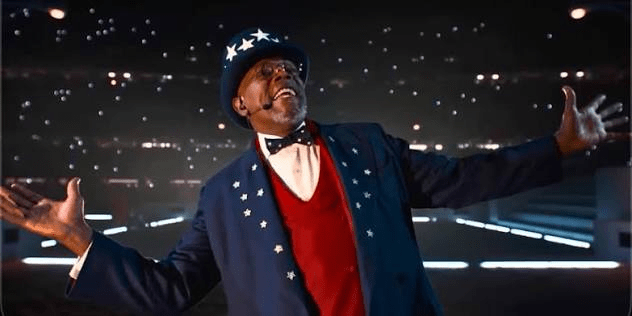
Samuel L. Jackson as Uncle Sam in Kendrick Lamar’s Super Bowl LIX Halftime Show in 2025.

Verse 2

The whole world is uneven / From the king to the heathen slave / ‘Cause ol’ Hitler and Mussolini is sendin’ millions to their lonely graves

Verse 2

Here the song touches on social issues beyond the threat of war, such as social inequality. It’s also notable that here we have the first mention of slavery on an album that features a large number of Black performers.

Verse 3 & 4

The songwriter shares the first of a series of ill-wishes for both Hitler and Mussolini. He’d rather see Hitler’s head chopped off and be done with it. The next best thing would be a rapidly-spreading (“galloping”) tuberculosis. And, for Mussolini, cardiac arrest with a side of insanity.

Verse 5

This war would soon be over, if Uncle Sam would use my plan / Let me sneak in Hitler’s bedroom with my razor in my hand

Verse 5

Like in Verse 1, the singer offers some strategic advice to the US military, offering to quite literally take matters into his own hands.


Let’s keep the record spinnin’ with the next track: Hitler Blues by the Florida Kid


The Florida Kid

In all the worldwide web, there’s sadly just not much information available on The Florida Kid.

A 2025 Facebook post by Mojohand.com, which describes itself as “The One Man Blues Boutique,” offers this brief bio:

“The Florida Kid” was the recording alias of a little-known blues singer and pianist named Ernest Blunt…remembered primarily for a striking and topical song called “Hitler Blues,” recorded in 1940 in Chicago.

Beyond that single release, very little is known about Ernest Blunt. No substantial biographical details or additional recordings have surfaced under his name or alias. He stands as a mysterious figure in blues history—one of many regional musicians who briefly entered the studio, captured a moment in time, and then disappeared from the public record. “The Florida Kid” remains a fascinating footnote in the story of American blues.”

The Release

Recorded in 1940, this is the earliest track we’ve encountered so far.

Track 5: Hitler Blues – The Florida Kid

Genre/Style: Blues, Chicago Blues
Year: 1940
Players: The Florida Kid

Listen & Read

Listen to the song again while reading the lyrics.

The Song: Overview

Structure
Six Verses w/ a Chorus

The Lyrics

This song takes a personal, rather than historical or political approach, with Hitler acting almost like a bogeyman looming in the shadows, waiting to strike when you least expect it.

Well, baby, have you heard about Hitler? / Honey do you care? / May be on the way to our country / May heavy-hit us here

Verse 1

The singer is a man addressing a woman. He starts out sweetly, calling her endearing names like “baby” and “honey.”

Because old Hitler, he’s a bad man / Trying to take every country he know / Well, before he take this country, woman / Please be my so-and-so

Chorus

He also uses the impending threat of war as a way to try to get laid. This made me chuckle, bringing to mind the “You don’t want to die a virgin, do you?” line from the movie Independence Day (1996).

Still, there’s something kind of cute about his plea for the woman to “Please be my so-and-so.” He gets a little more forceful in Verse 2, repeatedly demanding to be brought “plenty lovin’,” which is admittedly less cute.

Well, Hitler say he was a man / From his feet to his chest / He don’t bar nobody but / God and Death

Verse 3

There’s almost a sense of admiration for Hitler’s toughness in Verse 3. The phrase “don’t bar nobody” I take to mean something like he doesn’t concern himself with the opinions of, or take any shit from, any living human being.

Hitler got his just-right tanks / His planes and ships / He get over your town / He’ll let his big bomb slip

Verse 4

The final line of Verse 4 hints at a possible euphemism in the same vein as Outkast’s ‘Bombs Over Baghdad.’

Hitler says some of our peoples are white / Says some are brown and black / But Hitler say all Americans to him / Look just alike

Verse 5

While the previous track is the first to mention slavery, this is the first mention of race in the album. There’s obviously a lot to be said on both topics, but I’ll leave those large reflections for a later date.

Well, you better mind how you get drunk / Be careful how you clown / You may wake up one of these mornings / And Hitler be wreckin’ your town

Verse 6

The song ends with some closing words of caution. I appreciate that his message is not to stop getting drunk and clowning—The Kid is no buzzkill. He just asks his countrymen to be a little more mindful in how they go about their intoxicated buffoonery.


Links for ‘War Time Blues’

Song Lyrics – Genius
Artist Page – Wikipedia
Artist Page – Web

Links for ‘Hitler Blues’

Song Lyrics – Genius


Come Back Next Time for Tracks 6 & 8!


Disclaimer

~Content was created without the use of A.I.~
~Media content may be subject to copyright~
~Original content © Adam Astra 2026~
Text reads: "This Music Kills Fascism"

“Kickin’ Hitler’s Butt: Vintage Anti-Fascist Songs 1940-1944” – An Annotated Playlist (Introduction)

“Kickin’ Hitler’s Butt: Vintage Anti-Fascist Songs 1940-1944” – An Annotated Playlist (Introduction)

Welcome!

Welcome back to the blog, comrades! I’m trying something new that I hope will be of interest to many of you—my first annotated playlist! This introduction is being published simultaneously with Part 1 of this 10-part series. If I’m feeling ambitious once I’ve finished, I may try to consolidate it all into a single mega-post. But for now, I’ll be posting weekly through the new few months. So be sure to check back regularly.

Due to a lack of availability, I have recreated this album as a playlist on YouTube, collecting the highest-quality videos from verified sources. All of the songs except ‘Hitler Song’—credited to Josh White and Lead Belly—are included (more on that later). For increased ease of access, I’ve linked the playlist via TuneMyMusic, which lets you stream a playlist on your platform of choice. That said, I recommend listening on YouTube, as track availability on other platforms will vary. If you happen to give my page a follow while you’re there, I’d be much obliged : ) 

~~Stream The Album Here~~


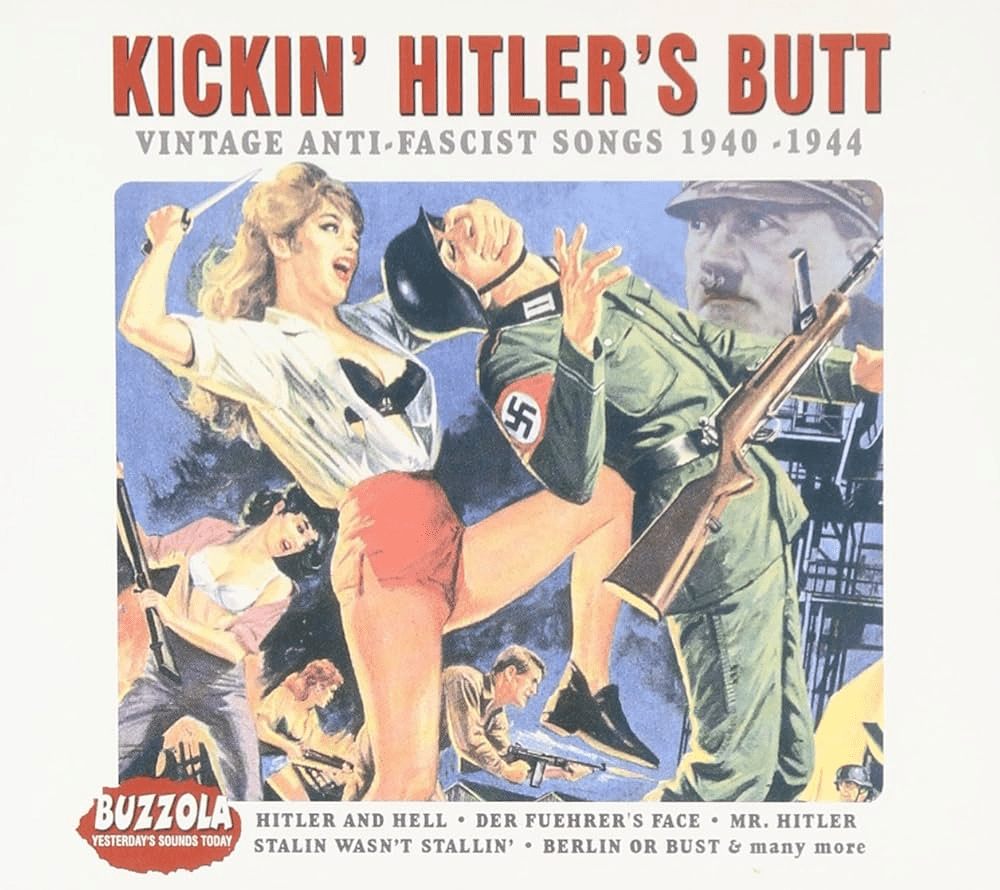
Album Cover

About the Album

The Release

This album was released in the UK on May 13, 2007. Three companies were involved in the production, manufacturing, and distribution of the album: Buzzola, Chrome Dreams, and Gonzo Distributed. This release may have been limited, as the album is not currently widely available. I don’t currently own a copy myself, but I hope to track one down eventually and get a look at that sweet “full-colour booklet.” (PS I don’t give money to Amazon.) 

Product details list the album as having a single disc, which is a little surprising. With 18 songs included, I assumed it would be a two-disc set, primarily to avoid loss of audio quality due to compression. Unfortunately, without having the physical album or even a streamable version available, I’m unable to compare the sound quality of this “remastered” release to other releases of the same recordings. 

The Title

“Kickin’ Hitler’s Butt” is a fun title, right? I was surprised to see the term ‘Anti-Fascist’ in the subtitle, as I tend to think of it as a more modern term (its shortened form ‘antifa’ certainly is). So it was interesting to see it in reference to songs from the early 40s. Then again, this compilation was released in 2007. Nowadays, the idea of ‘anti-fascism’ has been somewhat compromised by the mischaracterization of ‘antifa’ as not just a socio-political organization, but a domestic terrorist organization. In reality, this is the result of a deliberate misunderstanding; nothing more than a right-wing pipe dream invented to provoke a fear-driven political base—people unable to wrap their heads around this simple concept: to condemn anti-fascism is to condone fascism.

The Art

The cover art is clearly inspired by pulp comics and American dime novels of the ear. I love how literally the art (designed by Jon Storey) takes the album’s title. Front and center, we have a woman with her knee in a nazi’s back, but it’s clear she’s threatening more than “kickin’ butt.” She’s smothering him with her left hand, and that’s definitely a dagger in her right—with a point that seems destined for that nazi punk’s windpipe. In the background, two more badass women brandish rifles, and a man fires a machine gun at an SS officer; all while, in the upper-right-hand corner, the floating head of der Führer looks towards his anti-fascist attackers with an ‘oh shit’ look on his face.

Are these depictions of bodice-ripped beauties a bit gratuitous? Sure. Entirely unnecessary? Definitely. Do they help to grab your attention? Yep. I asked my wife how she felt about the art, and she said that, yes, on one hand, it’s gratuitous, but on the other…she would buy a calendar of pin-up girls kicking nazi ass. So there you go. 


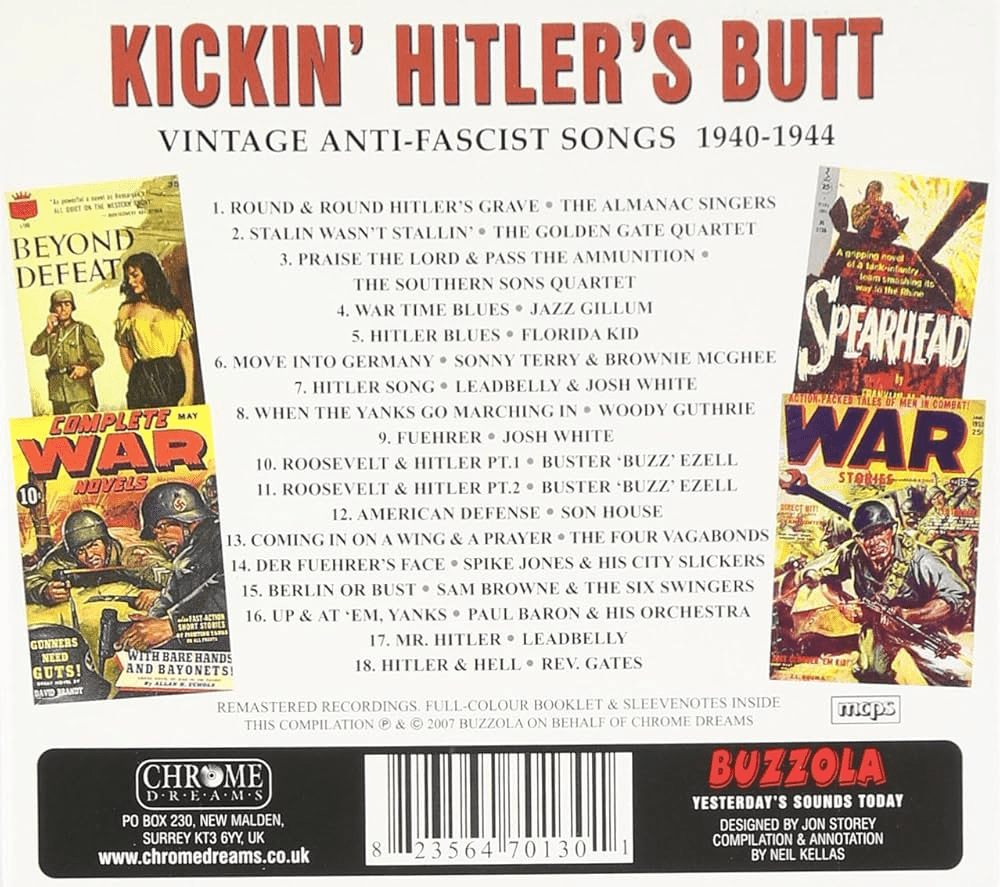
Back Album Cover and Track Listing

The Music

Genres and Styles on the album are impressively varied, including: Jazz, Blues, Brass & Military, Folk, Country, Easy Listening, Big Band Swing, and Acapella Vocal. And there are some big names on this album, including tracks by Lead Belly and Woody Guthrie (two major contenders for Protest Song GOAT), Pete Seeger (with folk supergroups The Almanac Singers and Union Boys), and Josh White, who outdoes them all with his stunning ‘Führer’ (Track 9). Not to mention the most popular track on the album, the zany ‘Der Fuehrer’s Face’ (Track 14), a Walt Disney-produced lampooning of Hitler and the nazi ideal of “der master race” by Spike Jones & His City Slickers.

That’s all I’ll say about the music for now. Come back for the next ten posts for MUCH more on that.

My Approach

First and foremost, although I am a writer and musician, I’m approaching this project as a music fan and, of course, a huge fan of anti-fascism. I came upon this album during a deep dive into American Protest Music, beginning with the protest songs of Lead Belly, which seemed as good a starting point as any. This research will also inform other posts, such as my upcoming ‘How to Write a Protest Song’ series. 

What I’m not is any kind of authority on music, WWII, or history in general. Many of you will likely be more educated than I am on some of these topics. Nor am I aiming to write a typical review. Rather, I’ll approach each track as an exploration and a conversation. At times, I may ask questions that I don’t immediately have answers to. You may even be able to help me solve a few mysteries along the way. I encourage feedback and am always open to suggestions. So please, I’d love to hear your thoughts and ideas. All are welcome here! 

Links

“Kickin’ Hitler’s Butt” Playlist – YouTube
“Kickin’ Hitler’s Butt” Album Page – Discogs
“Kickin’ Hitler’s Butt” Album Lyrics – Genius


Special Thanks Go To:

  • Genius user AndyMeister, who seems to have supplied the lyrics for every track on the album.
  • Reddit user geshchichtsklitterung from the /blues sub for research assistance.

Disclaimer

~Content was created without the use of A.I.~
~Media content may be subject to copyright~
~Original content © Adam Astra 2026~

Text reads: "This Music Kills Fascism"

Woody Guthrie & The Folk National Anthem

Woody Guthrie, half-length portrait, facing slightly left, holding guitar] / World Telegram photo by Al Aumuller (1943). Courtesy of Library of Congress.
Woody Guthrie (1943). Courtesy of Library of Congress.

*This is the first post in a larger exploration of American Protest Music, Songwriting, and Poetry. If you enjoy this post, please subscribe, share, and comment. Thanks for your time and attention, comrades!

“This Land is Your Land”The Folk National Anthem

Here in the US, we have an official National Anthem and a Black National Anthem, “Lift Every Voice and Sing.” Closer in spirit to the latter, I say there’s room for another—a Folk National Anthem—and I can’t think of a better candidate than Woody’s best-known song. A song that celebrates not only the unity of a nation, but calls for the sharing of its bounty, champions its freedom-demanding spirit, and honors the glorious diversity found in its natural wonders, its bustling cities, and its hopeful inhabitants.

For me, “This Land Is Your Land” embodies the best kind of patriotism: a love for your country celebrating its wonders and its people, whose impact far exceeds the ‘official’ anthem, with its flag-waving, war-glorifying nationalism. Maybe there’s still a place for the lofty and bombastic “Star-Spangled Banner,” but at this moment, for me, every note of it rings hollow. If this is a democracy (even one on life-support), I should get a vote for my national anthem, and I cast my vote here.

The Radical Verses

Depending on your personal experience with Woody’s masterpiece, you may have expected the above recording to go on for two or three more verses. These verses—which Woody himself never recorded, and were therefore not widely known until much later, thanks to the efforts of his son, Arlo—are sometimes called radical and socialist and bring it into the realm of the protest song.

The ‘complete,’ or ‘extended,’ version of the song may have been first performed by Pete Seeger and Bruce Springsteen as part of the “We Are One” concert for Barack Obama’s first presidential inauguration (January 18, 2009). While we’ll sadly never get to hear Woody sing this version in his own voice and style, performances like this still capture the spirit of both the song and the Great Poet-Folk Singer himself.

Patriotism & Protest

After watching the video above, I ask you to read the official song lyrics at woodyguthrie.org. Then decide for yourself which version you prefer. For me, “This Land Is Your Land” meets every requirement for a Folk National Anthem even without the additional verses. But with them, with their defiance of barriers in the name of freedom, critique of wealth inequality, and unwavering spirit of self-determination, it becomes not just an anthem, but one of the greatest protest songs ever written. I say it’s time (past time) to embrace and bring into balance both of these aspects—the hopeful patriotism and the defiant protest—not just in “This Land Is Your Land” and similar works of art, but in our communities, our families, and ourselves.

One Nation, Many Anthems

Who says that a nation needs to be limited to one (or even a small number) of national anthems? A nation’s anthems should be as numerous and diverse as its peoples. So let’s embrace the Black National Anthem, a Folk National Anthem, a Mexican-American National Anthem, a Trans National Anthem, and on and on. After all, the US is not a melting pot, with all cultures melding into a single, flavorless homogeny. It will take many voices, singing many anthems, to bring this nation into harmony.

Dig Deeper

Read
– More Official Lyrics from woodyguthrie.org
– Song Page from Wikipedia
– The Story Behind the Song from Library of Congress
This Land is Your Land Picturebook (2020)

Watch
This Land Is Your Land: The Story of an American Anthem – YouTube

~Content was created without the use of A.I.~
~Media content may be subject to copyright~
~Original content © Adam Astra 2026~