

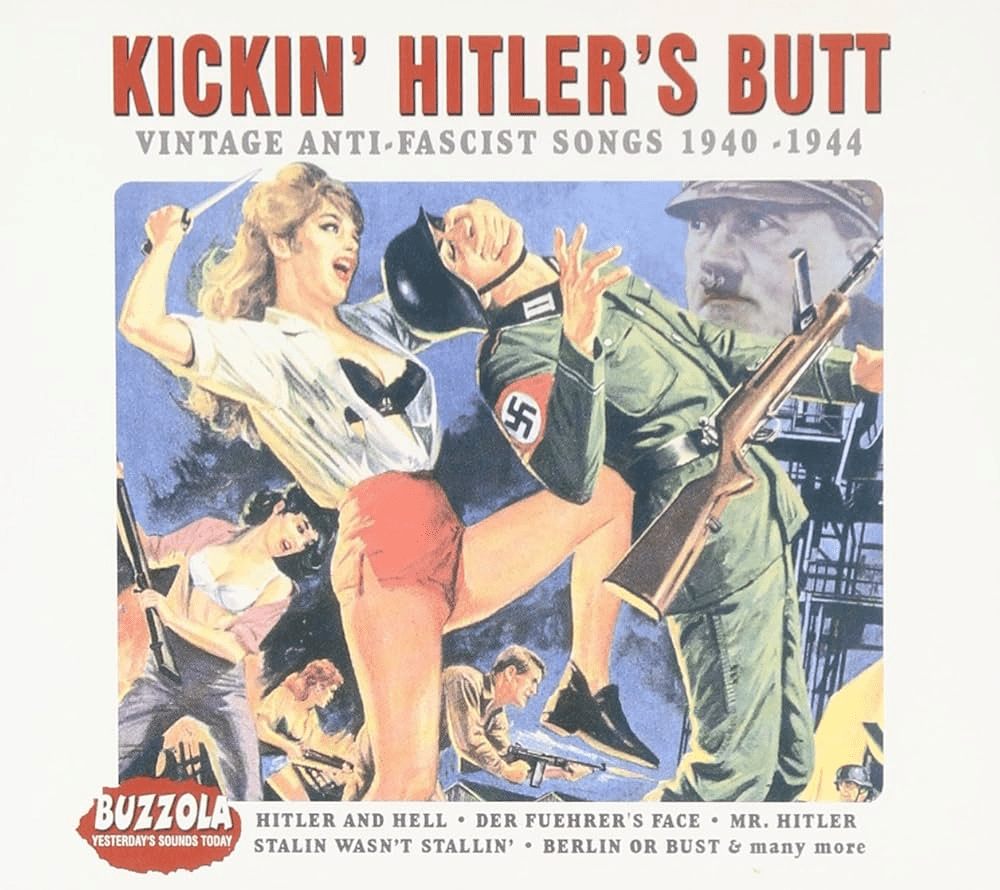
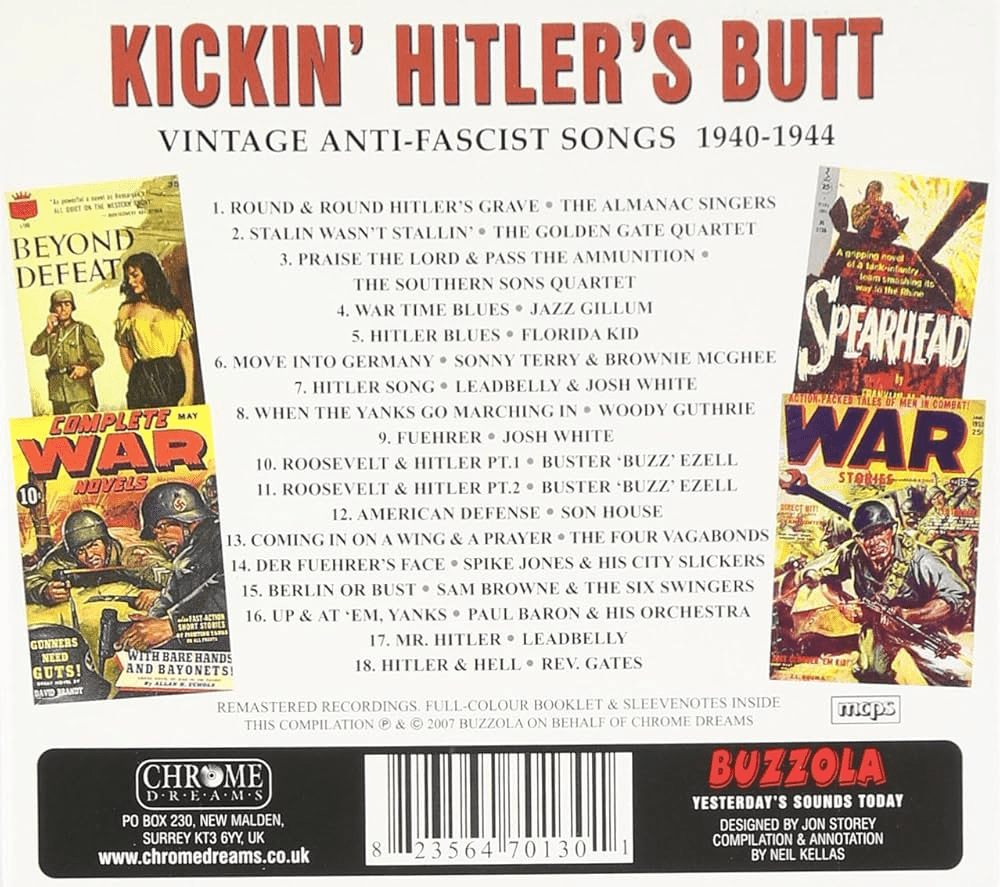
“Kickin’ Hitler’s Butt: Vintage Anti-Fascist Songs 1940-1944” – An Annotated Playlist (Track 3)
Welcome Back!
Today we’re discussing Track 3: ‘Praise the Lord & Pass the Ammunition,’ a song that shares many similarities with our last track, ‘Stalin Wasn’t Stallin’.’ In fact, one of the early members of the Golden Gate Quartet, William Langford, left that group to form a new one, which he called…you guessed it, the Southern Sons!
Other similarities include:
- All-male, all-Black gospel vocal group from the Southern US.
- Formed in the 30s and is still active today, but with an ever-changing lineup of vocalists.
- Features at least one section where the primary lyrics are spoken, or more specifically, sermonized.
- Lyrics feature clever wordplay.
There are also a few key differences:
- Unlike our previous track, this song wasn’t written by one of its members, but by acclaimed songwriter Frank Loesser, who we’ll discuss later.
- The group is a quintet rather than a quartet, featuring a fifth member, a second baritone.
- While the recording is technically “unaccompanied,” there are sound effects interspersed throughout.
If you’re joining us for the first time, welcome! While in one way each discussion will build on the last, ultimately I’ve organized the series in a way that allows each post to stand on its own. If you have yet to listen to the album, this link will take you to my recreation of it in the form of a YouTube playlist. If you happened to give my channel a follow while you’re there, I’d be much obliged : )
If you’d prefer to start at the beginning of this series, here’s a link to the Introduction.
Before we listen to today’s track, let’s set the stage with a little background info.
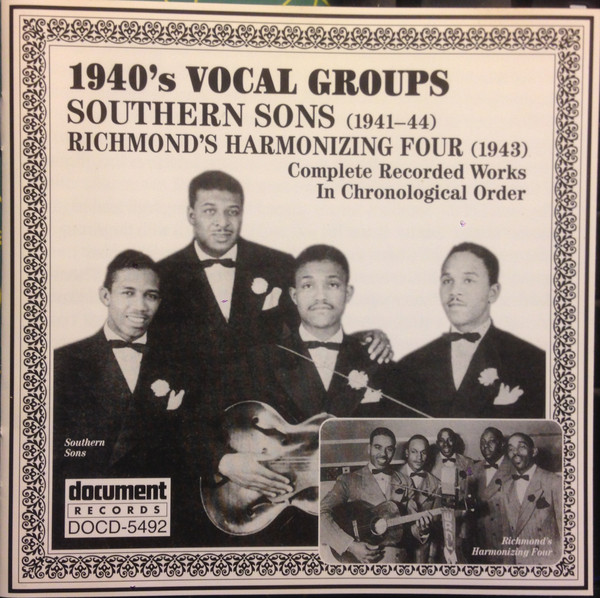
Who Were the Southern Sons?
Details about the Southern Sons are frustratingly hard to come by. We learned in our post for Track 2 that William Langford, tenor and founder of the group, left the Golden Gate Quartet sometime between 1938 and 1940. His motivations for doing so are not clear, but, interestingly, he chose to create not another quartet, which was the standard form of this type of vocal group at the time, but a five-piece quintet.
Here’s my best guess at the line-up at the time today’s track was recorded:
Tenors: William Langford, Kissler James Baxter
Baritones: Wesley Hall, Howard Wilson
Bass: Clifford Givens
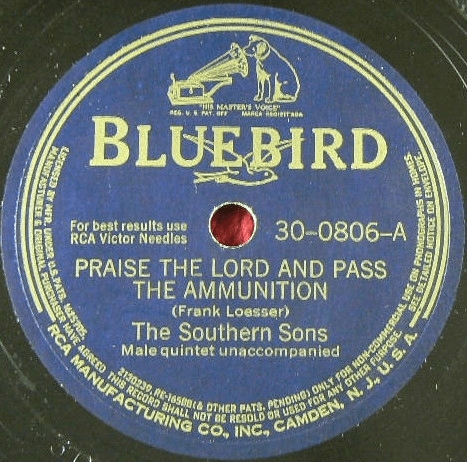
I say ‘best guess’ because personnel records for individual recording sessions are inconsistent. We know that today’s track was recorded in October of 1942 in New York for Bluebird, a subsidiary of RCA Victor. But we don’t have a personnel record for that particular session. What we do have is a personnel record of a session from August of that year, and we’re going to have to assume there were no line-up changes for the group in the two months between that session and the one that produced today’s track, along with its B-side, ‘Lift Every Voice and Sing.’
The Songwriter
New York City songwriter Frank Loesser was both prolific and highly decorated. In addition to providing songs for over sixty Hollywood films, he wrote the music and lyrics for the Broadway musical juggernaut Guys and Dolls, which earned him a Tony Award. Outdoing himself, he was awarded a Pulitzer Prize for Drama for How to Succeed in Business Without Really Trying, and later an Academy Award for the holiday staple ‘Baby, It’s Cold Outside.’ It’s not an EGOT, but it’s arguably just as impressive.
The Release
The song was first published as sheet music in 1942 and quickly became a best seller. Although the song was a relative hit for the Southern Sons, their version was not the most popular, and the group itself didn’t enjoy the same success as even The Golden Gate Quartet. Though the song has a Wikipedia page, the Southern Sons do not. In fact, they’re not mentioned in that article. The most popular version of the song was by Kay Kyser and His Orchestra, which was released at about the same time.
Legacy
If the title phrase (but not the song itself) sounds familiar, you likely have Serj Tankien of the alt-metal band System of a Down to thank for that. His 2007 protest song from the album Elect the Dead is a very different take on the theme suggested by the title. You can read the full lyrics of his version here. Serj and System play an important role in the evolution of protest music, particularly in the early aughts, so we’ll discuss them in more detail in the future.
And Now…Today’s Track!
Track 3: Praise the Lord & Pass the Ammunition – The Southern Sons Quartet
Genre/Style: Vocal (Male), Gospel, Patriotic
Song by: Frank Loesser
Year: 1942
Length: 3:12
Singers: Kissler James Baxter, William Langford, Wesley Hall, Howard Wilson, Clifford Givens
Listen & Read
Listen to the song again while reading the lyrics.
The Song: Overview
Structure
V1-C1-V2-B1-V3-C2-B2-C3-Outro
Note that this structure, with two bridges and and extended outro, is fairly unusual. And I’m not sure this format favorably impacts the trajectory of the song, particularly in the second half. I’ll discuss this more in the Outro section of this post.
Music
While there are no instruments in this recording, the first thing you hear are not vocals, but sound effects, which make the production unique. I’m unsure if these sound clips are from real-life military air battles, or were made in a studio for entertainment purposes, though I suspect the latter.
Compared to Track 2, this song is more playful with its vocal arrangement. In particular, Cliff Givens’ bum-pum-bumming bassline gives the song bounce and propulsion. Hand claps lend additional rhythmic texture.
Lyrics
Story
Of the songs we’ve covered so far, the lyrics for this one tell the strongest story. Right away, we’re introduced to characters (the Gunners and the Sky Pilot), and we know exactly where they are (in a plane) and what’s happening to them (getting shot up in a dogfight).
If you’re interested in learning more about what it was like to be a gunner in a WWII bomber, this article that describes the experience in detail, told by someone who was in the hot seat himself.
In the article “The Life of a Ball Turret Gunner” journalist Bob Podurgiel describes the experience of Santo Magliocca, who had “one of the loneliest jobs imaginable – Ball Turret Gunner on a B-24 bomber, flying missions over Nazi-occupied Europe.”
Santo flew 23 combat missions with the 451st Bombardment Group, 15th Air Force out of Foggia, Italy. His job was to hang alone, suspended underneath the bomber in a rotating bubble where he manned twin .50-caliber machine guns.
The Plexiglass and aluminum sphere was only 3.5 feet in diameter, large enough to fit a small man curled up on his back almost in a fetal position.
The guns’ barrels were positioned between the gunner’s feet and the hydraulic motors that rotated the sphere were by his head.
The ball turret gunner could actually spin his turret 360 degrees, as well as up-and-down to a 90 degree angle from the ground.
Designed to protect the bomber from German fighter attacks below, the turret was so cramped the gunner couldn’t wear a parachute.
If the B-24 took a direct hit from enemy flak, sending the plane into a death spiral, Santo, like all Ball Turret Gunners, had to crawl back into the plane’s fuselage before he could put on a parachute to bail out.
Wordplay
Rhyme Time
Verse 1, with its AABB rhyme pattern, varies slightly from the other verses.
The other sections feature rhymes that play off of the Chorus:
- From “Lord” we get “afford” (V2) and “aboard” (V3).
- From “Ammunition” we get “position/wishin/perdition” (V2) and “mission/fishin'” (V3).
- From “Free” we get “sea” (V2), and “he” (Bridge).
Anatomy of a Song
The Title
This seems to be a song born out of a title, with a title born out of legend. I don’t believe songwriter Frank Loesser claims any authorship of it. If the title quote originated from a clergyman at all, it was most definitely not from one in a plane. The more plausible account, offered in the Wikipedia song page, place the “sky pilot” aboard a warship, such as the USS New Orleans, during the attack on Pearl Harbor.
Regardless of who said it (and where), let’s explore the phrase to see if we can figure out what makes it so catchy:

1. Meter. The line is written in perfect dactyllic meter, with a strong (or stressed) syllable, also called a beat, followed by an unstressed, or weak one. This is written / u. Alternatively, strong beats are sometimes written in all caps: PRAISE the LORD and PASS…etc. You may be familiar with dactyllic’s mirror image, the iambic, written u /, which was a favorite of Shakespeare and other poets of his era. This meter is carried through much of the song.
2. Alliteration & Consonance. There is clear repetition of the “P” sound in the words “praise” and “pass,” and both fall on a strong beat. Those two words also end in an “S” sound, but since those are at the end of the word and not the beginning, that repetition counts as consonance, rather than alliteration. Similar techniques can be found throughout the rest of the song.
3. Contrast & Misdirection. The second action does not seem to follow directly from the first. If you were to read the fragment “Praise the Lord and—” you would likely expect it to continue along the same lines; something religious, probably taking place in a church. Instead, we get an unexpected shift. We are suddenly at war, with bullets whizzing by our heads.
Verse 1
Down went the gunner / A bullet was his fate / Down went the gunner / And then the gunner’s mate…
Verse 1, Lines 1-2
The first verse starts us right in the middle of the action. We’re in a deadly dogfight and the gunners themselves are getting gunned down left and right.
When I first read the term “sky pilot,” I assumed the song was referring to an actual pilot, the aviator of the aircraft. And it seemed unlikely that even the most devout pilot would be reading a book (even “the Book,” aka the Bible) during an active air battle.
With a little research, I learned the epithet “Sky Pilot” did not describe a pilot at all, but a clergyperson, or chaplain. Interestingly, Eric Burdon and the Animals released a song about a military chaplain called ‘Sky Pilot’ in 1968. Unlike the title character in this song, Burdon’s “Sky Pilot” was anything but a heroic figure.
The Chorus
The Chorus is repeated three times throughout the song without variation of lyrics or music.
Praise the Lord and pass the ammunition…And we’ll all stay free
Chorus
The Chorus features a simple repetition of the title three times, followed by the phrase “And we’ll all stay free. This final line could be tacked onto the end of about any patriotic refrain, and is admittedly a tad generic.
Bridge
Yes, the sky pilot said it / You gotta give him credit / For a son-of-a-gun of a gunner was he
Bridge
The propulsive rhythm of the lines ‘sun-of-a-gun of a gunner’ could be a playful way to echo the rat-a-tat-tat-tat of machine gun fire.
Outro
Tenor James Baxter delivers the closing outro, or rather, sermon, repeating the lyrics from earlier sections of the song in an elevated spoken style. While this change adds an element of variety to the song, I’m afraid, at least for me, this is where the track loses momentum, ultimately coasting into the finale on little more than fumes.
Reflections
For all its strengths, the themes of the song could be viewed as problematic from a modern perspective in several ways:
- Guns & God. The title phrase is one that seems bound to be co-opted by the…other…kind of patriot. I can imagine it stuck to the bumper of a flag-waving pick-up truck as it belches black smoke from oversized exhaust pipes. These are the same folks who believe “thoughts and prayers” to be a sufficient response to the mass-shootings that all too frequently terrorize US schools and other public spaces.
- Glorification of Violence. The story told in the song highlights the danger and excitement of an air battle, but does not reflect upon the loss of life (the two gunners) even a little.
- Jingoism. Jingoism, or extreme nationalism, is a far cry from the freedom-loving patriotism which it pretends to be. And elements of this song, along with several other songs on this compilation, could justifiably be seen as falling on the wrong side of the jingoism/patriotism divide.
With God on Our Side?
I’ll leave you with the final lines of Bob Dylan’s 1963 anti-war masterpiece, ‘With God On Our Side’:
The words fill my head / And fall to the floor / If God’s on our side / He’ll stop the next war
With God On Our Side, Final Lines
Links
Song Lyrics – Genius
Song Page – Wikipedia
Frank Loesser – Wikipedia
Southern Sons – Discogs
Song Page – SecondHandSongs
Special thanks to Rate Your Music user bayard for group biographical information.
Come Back Next Week for Tracks 4 & 5: ‘War Time Blues’ and ‘Hitler Blues’!
Disclaimer
~Content was created without the use of A.I.~
~Media content may be subject to copyright~
~Original content © Adam Astra 2026~

 Adam Astra