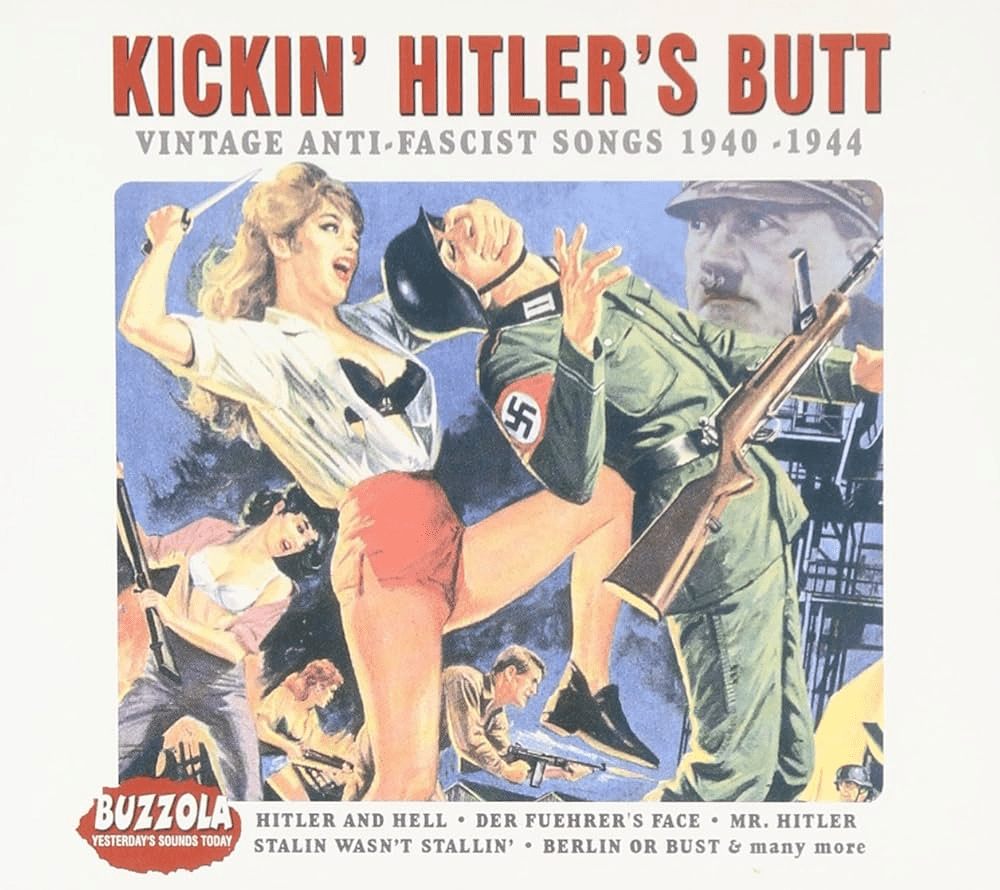
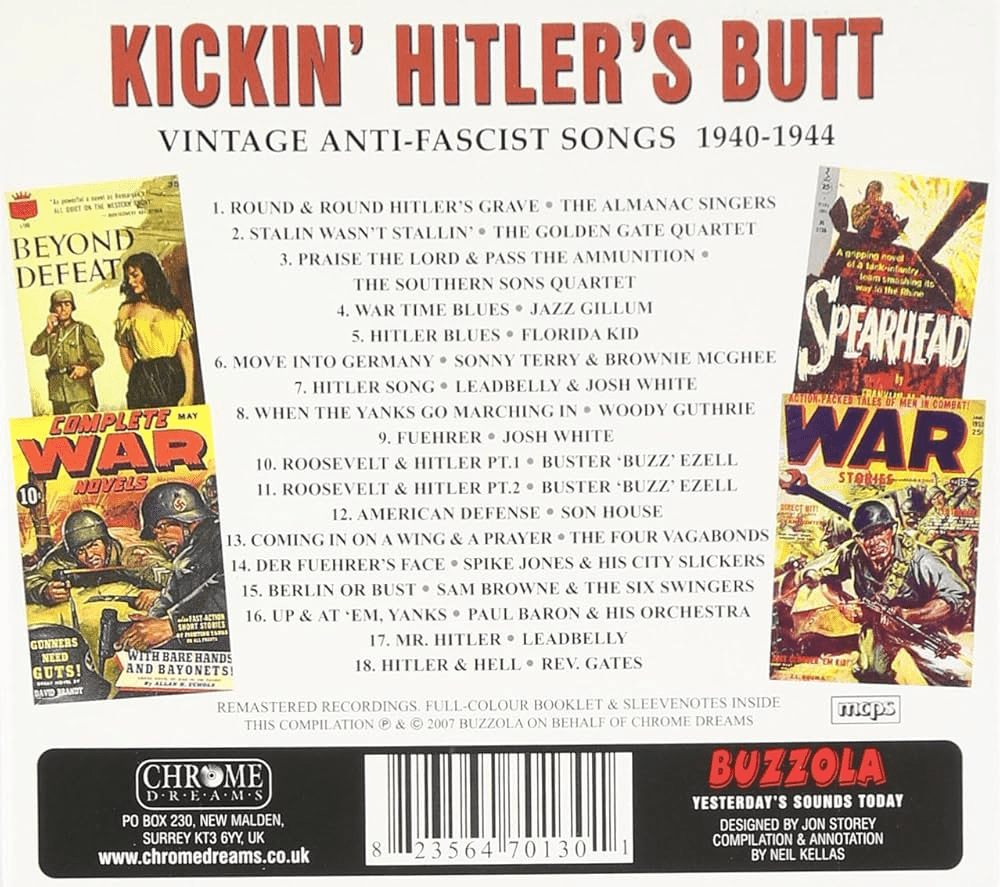
“Kickin’ Hitler’s Butt: Vintage Anti-Fascist Songs 1940-1944” – An Annotated Playlist
Welcome!
Welcome to the first of ten posts exploring this terrific collection of protest songs. Today we’ll be discussing the first track on the album, ‘Round & Round Hitler’s Grave,’ by The Almanac Singers—an anti-fascist ditty you can do-si-do to!
The Almanacs do more than dance on Hitler’s grave…they hoot, holler, whistle, and wail around it, all while picking, strumming, and singing about the many ways they’d like to bring about his untimely demise. This is a proper high-spirited hootenanny, with a real sense of joy in the performances, proving you can fight fascism and have fun at the same time.
Pete Seeger (voice, banjo) takes the lead in each of the six short verses, with the Almanacs jumping in with a lively chorus after each, and Sis Cunningham bridges the gaps with a playful accordion part.
If you missed the Introduction to this series and you want to know more about the album, you can find it here.
Before we dig any deeper, let’s give the song a spin!
Track 1: Round & Round Hitler’s Grave – The Almanac Singers
Genre/Style: Folk, Country
Year: 1941/1942
Song by: Pete Seeger, Woodie Guthrie, Millard Lampell
Players (shown below, from left to right): Woody Guthrie (guitar), Millard Lampell, Bess Hawes (guitar), Pete Seeger (banjo), Arthur Stern, Sis Cunningham (accordion)
The Almanac Singers
“In 1940…the group climbed into a midnight blue Buick and blazed a trail across the United States, spreading the gospel of unionism and bringing folk music back to the people. Creating a new kind of topical music, The Almanac Singers used old folk melodies to tell the stories of the time while planting seeds wherever they went. They played at parties, rallies, benefits, unions meetings, and informal “hootenannies”, a term Pete and Woody learned on an Almanac tour of Portland and Washington.” – Bob Wolpert (2025).
The folk Protest supergroup known as The Almanac Singers (founded by Pete Seeger, Lee Hays, and Millard Lampell) grew out of the fabled New York City folk scene of the early forties. Today, the group is best known for their 1941 recording of the trade union song, ‘Which Side Are You On?,’ written in 1931 by American activist Florence Reece.
The Almanac Singers, Pete Seeger, and Woody Guthrie will all get their share of the spotlight in future posts (Guthrie sooner than the others, as he makes another appearance on this album), so I’ll save the biographies for another time. We’re here first and foremost to dance ’round Hitler’s grave, after all.
A Little Background on the Song
“We got to sing [the pro-war song, ‘Round and Round Hitler’s Grave’] on January ’42, on a nationwide CBS broadcast, ‘This is War’. But the next day a headline in a major New York newspaper said ‘Commie Singers try to Infiltrate Radio,’ and that was the last job we got” – Pete Seeger
No Wikipedia page for the song exists; the only direct mention of it on the site seems to be from the above Pete Seeger quote from his book Where Have all the Flowers Gone?, which shares a title with one of his best-known songs.
This song is not among the group’s most popular, which is one of the reasons I dig this compilation. In fact, the recording doesn’t appear on an album until 2001, when it appeared on the Songs of Protest compilation (Prism).
The Song: Overview
Verse 1
Now I wished I had a bushel / Wished I had a peck / Wished I had old Hitler / With a rope around his neck
Verse 1
They’re literally going for the neck in this first verse. The bushel and peck lines are about as stereotypically ‘folksy’ as you can get, and seem transplanted from another song, but they set up the rhyme with neck nicely.
You’ll notice right away how quickly these verses fly by. This song is really about the Chorus.
Chorus
Hey! ‘Round, ’round Hitler’s grave / ‘Round, ’round we go / Gonna lay that poor boy down / He won’t get up no more
Chorus
I suppose songs have been going ’round and ’round ever since people started singing and dancing. Doing so around someone’s grave brings to mind the idiom to dance on someone’s grave, which has been in use since at least the 1800s.
It’s generous to call Hitler a ‘poor boy,’ I take that expression as another bushel-and-peck style folkism.
The final line completes the slant rhyme (go/more) and is satisfying in its finality.
Sometimes I like to try to tune in on each singer’s individual voice as they sing in unison, and say to myself, “There’s Woody!” or “That must be Bess!”
Verse 2
Mussolini won’t last long / Tell you the reason why / We’re gonna salt his beef / And hang it up to dry.
Verse 2
Hitler’s not the only one in the line of fire here. The Almanacs also threaten to make beef jerky out of Mussolini. Or perhaps, since he’s Italian, he’d make a better bresaola: a type of aged air-dried salted beef known for its reddish-purple color.
Verse 3
The German army general staff / I guess they missed connection / Went a hundred miles a day / But in the wrong direction
Verse 3
I don’t believe this line is referring to a literal historical event (please let me know if I’m wrong). I think they’re merely poking fun at the German army and its inept leadership. Particularly, their ill-fated decision to prematurely invade Russia.
Verse 4
I’m goin’ to Berlin / To Mister Hitler’s town / I’m gonna take my forty-four / And blow his playhouse down
Verse 4
Look out! Pete’s got a gun! If you’re picturing the jovial folksinger brandishing a .44 Magnum, I’ve got some bad news: Dirty Harry’s infamous weapon of choice wouldn’t be in production for another fifteen years.
I have the impression that the phrase “blow (the) playhouse down” has some history in song, and I did a little digging, but without much to show for my effort. There’s a song called ‘I’m Gonna Tear Your Playhouse Down,’ written by Earl Randall and recorded by Ann Peebles (of ‘I Can’t Stand the Rain’ fame), but that came much later in 1972. Gillian Welch’s ‘Tear My Stillhouse Down’ came even later, in 1996. Perhaps “playhouse” is a clever nod to the expression “theater of war,” or perhaps I’m overthinking all of this.
Verse 5
How Hitler went to Russia / In search of Russian oil / But the only oil he’ll find there / Is a pot in which he’ll boil
Verse 5
Was Hitler really after oil in Russia? This quote from Atlantic Magazine sheds some light on the issue:
“Opinions may differ on the question of whether or not oil was the decisive motive for Hitler’s attack on Russia. But after ten months of the Russian campaign there can be no doubt of Hitler’s imperative need of the Caucasian oil fields…To achieve his purpose Hitler must have new oil supplies; and he must deprive the Soviet Union of hers.” – Frederick Phillip Hellin (June 1942 Issue)
The concept of an ‘oil war’ is certainly not a new one. I shouldn’t have been surprised to discover that the term even has its own Wikipedia page. As a child of the early 80s, I’ve followed the frontline news reports of one oil war after another with fascinated horror: The Iran-Iraq War (1980-1988), The Gulf War (1990-1991), The Iraq War (2003-2011), and here we are again in 2026, as if it will never stop, as if we’ll never learn.
Verse 6
Now Mister Hitler’s traveling mighty fast / But he’s on a one-way track / Started down that Moscow road / But now he’s coming back
Verse 6
Hitler tucks tail and runs in the sixth verse. Though it is the last, there’s nothing particularly final about the lines here. The feeling is more that this song could go on with any number of verses, ’round and ’round for as long as the players can keep it up, or even better, until all the fascists that plague humanity are tucked safely into their final burying ground.
Reflections
This is a protest song with a vibe miles away from Dylan’s iconic ‘Masters of War,’ with its cutting line, “I’ll stand over your grave until I’m sure that you’re dead.” And that’s part of what I like about it. Is this song among my favorites of this album? Yes. It is also among my favorites by this group, let’s say, somewhere in the Top 5. And it’s one I don’t mind getting stuck in my head.
As a performer, I probably wouldn’t cover it as-is, but I would like to try out the banjo part the next time I get my hands on one. I think you could have some fun rewriting the lyrics by either substituting in updated figures and events (a few should come immediately to mind), or generalizing in a way that says, more or less: Fuck ALL the fascists:
“Hey! ‘Round and ’round the fascist’s graves / ‘Round and ’round we go / Gonna lay the bastards down / Won’t get up no more”
Links
Song Lyrics – Genius
Song Lyrics – Woodyguthrie.org
The Almanac Singers – Wikipedia
Who Are the Members of The Almanac Singers – Facebook
Songs of Protest Album Page – Discogs
Oil War – Wikipedia
Come Back Next Week for Track 2: ‘Stalin Wasn’t Stallin”
Disclaimer
~Content was created without the use of A.I.~
~Media content may be subject to copyright~
~Original content © Adam Astra 2026~